
Factoring Versus Revenue Financing: Which Fits?
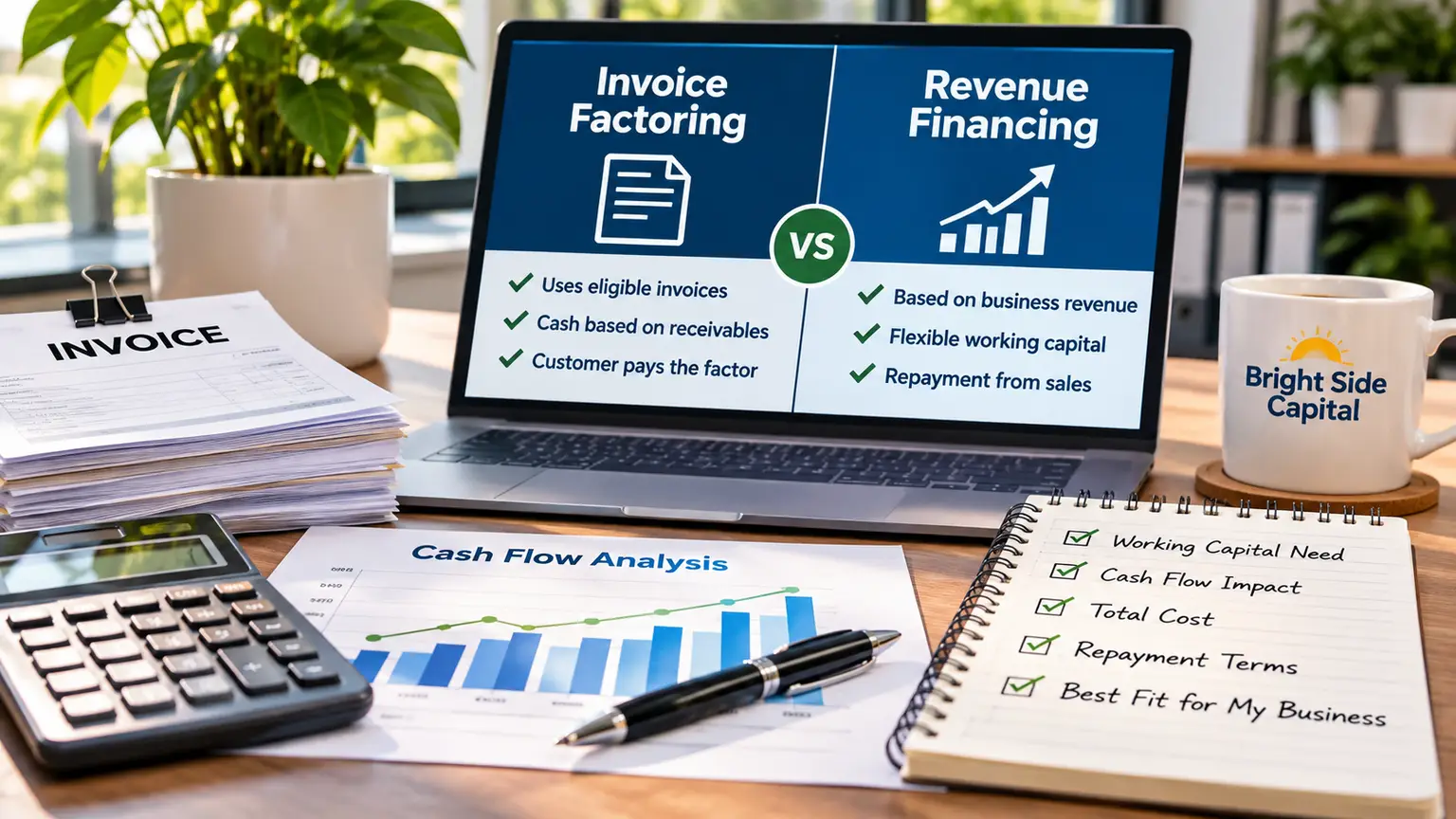
A large unpaid invoice can make a profitable business feel cash-poor. That is where factoring versus revenue financing becomes a practical decision: do you need to convert eligible invoices into working capital, or do you need financing supported by your overall business revenue? The appropriate choice depends on how your business gets paid, how predictable collections are, and whether the payment structure fits your cash flow.
The key difference: Invoice factoring generally involves selling qualifying unpaid business invoices to a factoring company. Revenue-based financing generally uses the business’s sales or revenue as a basis for providing capital and establishing repayment or remittance terms. Both may address short-term operating needs, but they differ in the assets involved, qualification process, payment mechanics, customer contact, and cost.
Factoring Versus Revenue Financing at a Glance
- What supports the financing? Factoring is tied to eligible accounts receivable. Revenue financing is generally evaluated using sales, deposits, or future business receipts.
- Who pays? Under many factoring arrangements, the customer pays the factor or a designated account. Under revenue-based arrangements, payments or remittances generally come from the business’s future receipts or bank account.
- What matters for qualification? Factoring places significant weight on invoice eligibility and customer creditworthiness. Revenue financing often emphasizes deposit consistency, revenue, operating history, and existing obligations.
- How is cost calculated? Factoring may involve invoice discounts, factoring fees, reserves, and transaction charges. Revenue-based arrangements may use a contracted repayment amount, financing charges, factor-based pricing, or other program-specific terms.
- What is the main risk to monitor? With factoring, consider disputed invoices, customer nonpayment, recourse provisions, and collection practices. With revenue financing, consider frequent withdrawals, sales volatility, and whether payments actually adjust when revenue changes.
These are general distinctions, not universal rules. The agreement determines whether a transaction is a loan, a purchase of receivables, or another commercial financing structure. Do not assume that every product labeled “revenue financing” operates the same way. For background on the first structure, see our guide to how invoice factoring works.
When Invoice Factoring May Make More Sense
Factoring may fit businesses that have already delivered goods or completed services and are waiting for eligible business-to-business invoices to be paid. Staffing firms, manufacturers, trucking businesses, distributors, and certain professional service companies can experience this timing gap. Some government receivables may also be considered, but assignment rules, contract terms, and provider requirements can affect eligibility.
Under a typical arrangement, the company sells qualifying receivables to a factoring provider and receives an agreed advance. The customer then pays according to the arrangement’s collection instructions. After the invoice is paid, any remaining reserve is settled, less applicable fees and adjustments. The advance amount, fees, reserves, and timing vary by invoice and agreement.
Because the receivable is central to the transaction, the customer’s credit profile and payment record may carry significant weight. This can create an option for a newer business with established commercial customers, but clean invoices and strong customers do not guarantee acceptance.
Factoring also brings operational considerations. The customer may receive a notice of assignment or new payment instructions. The factor may verify invoices or communicate about collections. If customer relationships are sensitive, ask how communications will be handled before signing.
Pay particular attention to recourse versus non-recourse factoring. A recourse agreement may require the business to repurchase or replace certain unpaid or ineligible invoices. Non-recourse protection is not necessarily comprehensive; it may cover only defined credit events and exclude disputes, offsets, performance problems, or other situations. The agreement, not the label, controls the actual risk allocation.
When Revenue-Based Financing May Be a Better Fit
Revenue-based financing may be worth considering when a business earns regular card, online, ACH, or other sales receipts but does not have eligible invoices to factor. A restaurant purchasing seasonal inventory, a retailer restocking proven products, or a home-services company funding a defined marketing campaign may evaluate this approach.
Rather than relying on a specific customer’s unpaid invoice, the provider generally reviews the business’s revenue and ability to support the proposed obligation. Depending on the program, underwriting may consider bank deposits, sales patterns, operating history, industry, credit, existing financing, and other factors. Our guide to business financing based on revenue explains why current sales can play an important role in the review.
The phrase “revenue financing” covers arrangements with different contractual structures. Some calculate remittances as a percentage of qualifying revenue or sales. Others collect scheduled daily or weekly amounts. Certain arrangements are loans, while others may be structured as purchases of future receivables. A merchant cash advance is one specific form of future-receivables financing, not a synonym for every revenue-based product.
That distinction matters when revenue slows. A true percentage-based remittance may fluctuate with eligible sales, while a fixed withdrawal may continue unless the contract provides for reconciliation or another adjustment. Before accepting an offer, confirm whether remittances change automatically, whether reconciliation is available, and how the process works in practice.
Daily or weekly payments can affect cash flow differently from monthly payments. Frequent withdrawals may be especially difficult for businesses with thin margins, seasonal sales, or multiple existing obligations. A revenue-based arrangement should support a defined business need rather than repeatedly cover an underlying operating loss.
Compare the Cash-Flow Impact and Total Cost
Begin with the source of cash. If a commercial customer owes $50,000 on an eligible invoice and that delayed collection is the immediate problem, factoring may align more directly with the transaction. If a company needs $50,000 for inventory and expects repayment to come from many future sales, a revenue-based structure may be worth comparing. These are illustrations, not statements that either transaction would qualify.
For factoring, estimate the advance received, any reserve withheld, the cost if the invoice is paid on time, and what happens if it is paid late. Ask whether there are minimum volume commitments, monthly minimums, renewal charges, or termination provisions. For revenue financing, compare the net cash received with the full contracted payment or remittance obligation and any additional charges.
Do not compare a factoring fee, factor rate, interest rate, and annual percentage rate as though they measure the same thing. Different products use different pricing conventions. Ask the provider to translate the arrangement into dollar amounts and explain how cost changes with collection timing or early payoff. Our guides to business financing fees and comparing complete funding offers provide a framework.
Next, stress-test cash flow. Can the business still pay employees, suppliers, rent, taxes, and existing obligations during a slower month? A large sales figure or a strong invoice balance does not establish that a new obligation is affordable. Timing, gross margin, other debts, and available cash reserves also matter.
Questions to Ask Before Choosing a Provider
For either structure, request the proposed agreement and ask how much capital will actually be available, what costs apply, what documents are needed, and what conditions remain before funding. In particular, confirm:
- For factoring: Which invoices qualify? What advance rate and reserve apply? Who contacts customers? When is the reserve released? What happens with disputes, late payments, recourse, minimum volumes, or termination?
- For revenue financing: Is the arrangement a loan or a purchase of future receivables? How is the payment or remittance calculated? Is the amount fixed or sales-based? Are reconciliation provisions available? What are the total obligation and early-payoff terms?
- For both: Are there UCC filings, collateral restrictions, personal guarantees, existing-lien conflicts, additional financing restrictions, or fees that could materially change the transaction?
Timelines vary by provider, documentation, receivables verification, underwriting, and any existing security interests. Neither option should be treated as automatically approved or guaranteed to fund within a particular period.
When Neither Option May Be Appropriate
Factoring may not fit a company that sells primarily to consumers, collects at the point of sale, or has invoices that are frequently disputed or not yet earned. Revenue financing may be difficult to sustain when receipts are highly unpredictable or existing daily and weekly withdrawals already consume much of the operating account.
Depending on the business and purpose, a business line of credit, term financing, equipment financing, or another working-capital structure may provide a better fit. If you are specifically weighing invoice factoring against a merchant cash advance, see our separate factoring versus merchant cash advance comparison.
Choose Financing That Fits How Your Business Gets Paid
Factoring versus revenue financing is ultimately a decision about the cash you already have a right to collect, the sales you expect to generate, and the obligations your business can reasonably support. Neither option is universally cheaper, faster, or easier to qualify for. Compare the complete agreement, the expected total cost, customer or payment arrangements, and the effect on operating cash flow.
Bright Side Capital uses a multi-program approach to help business owners explore and compare commercial financing programs and providers based on revenue, receivables, industry, use of funds, existing obligations, and repayment capacity. Availability, terms, fees, eligibility, and timing depend on the program and provider.
If you are evaluating factoring, revenue-based financing, or another working-capital option, complete the Bright Side Capital Business Survey to explore commercial financing options that may fit your business needs.