Business Loan Types: Options, Uses & Repayment
Business owners have several financing options, but not every product works the same way. Understanding the main business loan types can help you choose a financing structure that matches your use of funds, repayment capacity, and business goals. A short-term inventory purchase, a commercial vehicle, and a property acquisition create different financial needs.
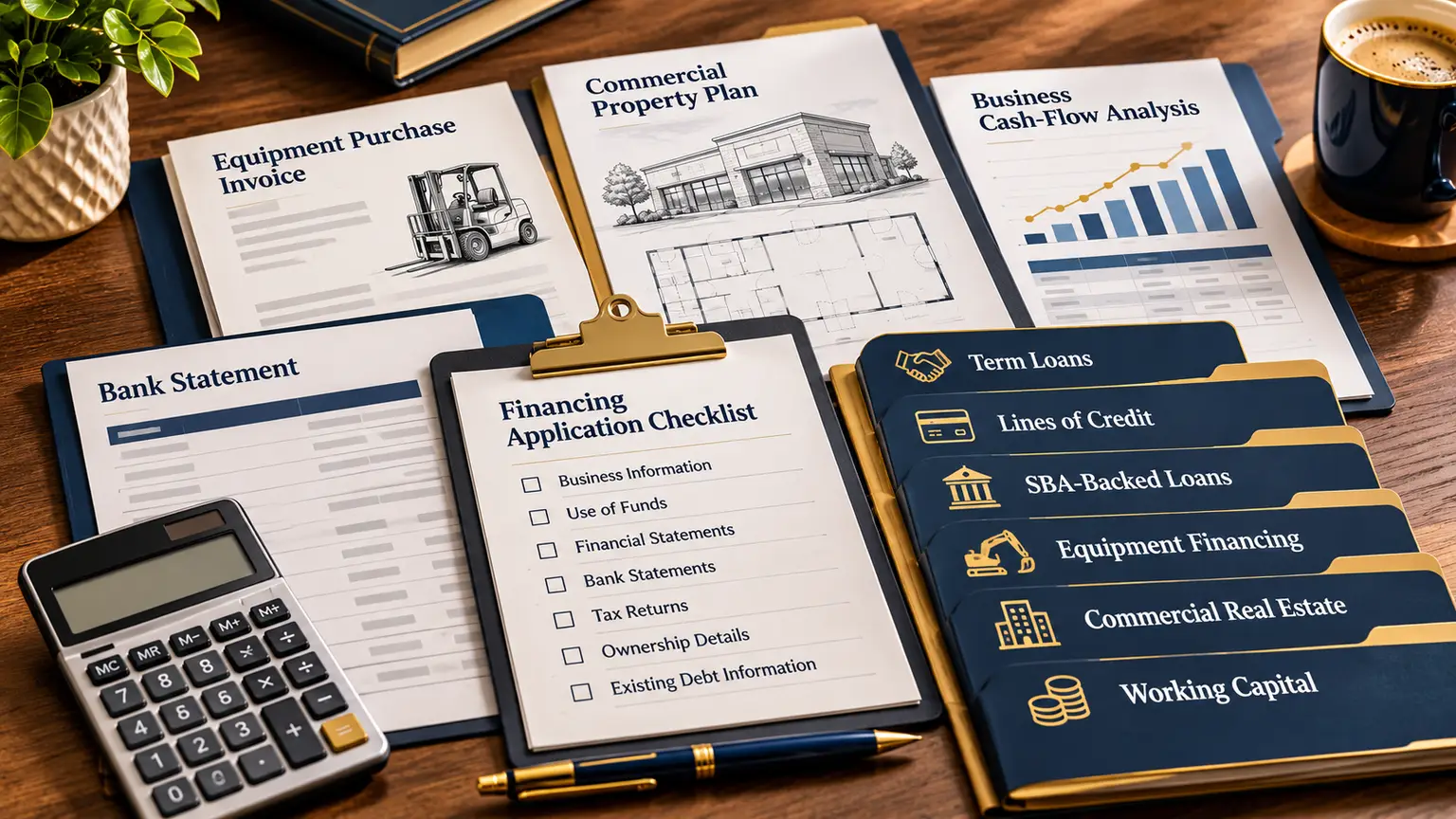
The short answer: Common business loan types include term loans, business lines of credit, equipment loans, SBA-backed loans, and commercial real estate loans. Businesses may also consider other commercial financing arrangements, such as invoice factoring, accounts receivable financing, and revenue-based financing. Not every arrangement in that second group is legally structured as a loan.
The appropriate choice depends on business revenue, cash flow, operating history, credit profile, industry, available collateral, existing obligations, and the purpose of the capital. There is no universal financing product that fits every company.
Business Loan Types at a Glance
Start by matching the financing structure with the business expense and expected source of repayment.
- Term loans: May fit a defined purchase, project, renovation, expansion, or other expense with a predictable repayment plan.
- Business lines of credit: May provide recurring access to capital for inventory, seasonal expenses, payroll timing, or other changing working-capital needs.
- Equipment loans: May help acquire machinery, commercial vehicles, technology, or other productive assets without paying the entire purchase price upfront.
- SBA-backed loans: May support eligible working capital, acquisitions, equipment, and certain real estate projects through participating financing parties.
- Commercial real estate loans: May support qualifying property acquisitions, improvements, construction, or refinancing.
- Receivables financing: May provide access to capital supported by eligible unpaid commercial invoices.
- Invoice factoring: Generally involves selling eligible invoices rather than taking out a conventional business loan.
- Revenue-based and future-receivables financing: May provide capital based partly on business revenue or expected receipts, with contractual structures and payment methods that vary.
These categories can overlap. For example, an equipment loan may be a form of term financing, and certain SBA-backed loans may fund equipment or commercial property. Understanding the structure matters more than relying on the product name alone.
1. Business Term Loans
A business term loan generally provides a defined amount of capital that the borrower repays over an agreed period. The financing agreement establishes the payment structure, applicable interest or financing charges, fees, maturity, and other obligations.
Term financing may be appropriate when a business knows how much capital it needs for a particular purpose. Examples include renovating a location, upgrading productive equipment, completing an expansion project, or refinancing eligible business obligations.
One potential benefit is a predictable payment schedule. Some loans provide fixed payments, while others have variable rates or different repayment arrangements. Longer repayment periods may reduce scheduled payment amounts, although they can increase total financing cost depending on the terms.
A business should also consider the timing of the expected return. If the project will take several months to generate additional revenue, payments beginning immediately may create pressure on existing operations.
For a more detailed discussion, see our small business term loan guide.
2. Business Lines of Credit
A business line of credit generally provides access to financing up to an approved credit limit. Instead of receiving the full amount at closing, the business may draw funds when needed, subject to the agreement and available credit.
Lines of credit may fit recurring or unpredictable expenses such as inventory replenishment, supplier payments, materials purchases, seasonal operating costs, and temporary cash-flow gaps.
Some revolving facilities allow available credit to replenish as outstanding amounts are repaid. Others have defined draw periods, renewal requirements, or restrictions that affect continued access.
Interest or financing charges may be based on outstanding draws, but maintenance fees, draw fees, annual charges, or unused-line fees may also apply. Business owners should confirm whether the facility is genuinely revolving and how repayments are calculated.
A credit line may be less appropriate when the business needs to finance a large investment that will take several years to produce its expected return.
Learn more in our business line of credit guide.
3. Equipment Financing
Equipment financing is designed to help businesses acquire assets used in their operations. Depending on the program, this may include construction machinery, delivery trucks, manufacturing equipment, commercial kitchen systems, medical devices, agricultural machinery, or business technology.
In many equipment-financing transactions, the purchased asset serves as collateral. However, equipment value alone does not determine approval. Financing providers may also review cash flow, credit, the business’s operating history, available down payment, and existing obligations.
Equipment financing can preserve working capital by spreading the purchase cost over an agreed repayment period. The financing term should be considered in relation to the equipment’s expected useful life and the benefit it provides to the business.
Before moving forward, include installation, delivery, training, insurance, maintenance, software, and other associated expenses in the project budget. These additional costs may or may not qualify under the same financing agreement.
Our guide to financing new business equipment explains how to evaluate an equipment purchase.
4. SBA-Backed Business Loans
The U.S. Small Business Administration supports several financing programs for eligible small businesses. The two major programs commonly considered for general business financing and major fixed-asset needs are SBA 7(a) and SBA 504.
SBA 7(a) Loans
SBA 7(a) loans are issued by participating lenders and supported by an SBA guarantee. Subject to program requirements, eligible uses may include working capital, equipment, business acquisitions, certain debt refinancing, leasehold improvements, and commercial real estate.
Depending on the transaction, 7(a) financing may provide repayment terms suited to longer-term investments. Eligibility, interest rates, guarantees, collateral, documentation, and closing requirements depend on SBA rules and the participating lender’s underwriting.
SBA 504 Loans
SBA 504 financing focuses primarily on qualifying major fixed assets, such as owner-occupied commercial real estate, construction, improvements, and certain long-term machinery or equipment.
A typical 504 project involves a Certified Development Company and a third-party lender. The financing structure, borrower contribution, interest rates, and repayment obligations must be evaluated together.
Unlike some eligible 7(a) uses, SBA 504 financing cannot be used for ordinary working capital or inventory. Purely passive investment-property purchases are also generally outside the intended use of these programs.
SBA-backed financing can involve additional documentation and review. It should not be treated as an automatically available solution for urgent business expenses.
For more detail, read what an SBA loan review checks before approval.
5. Commercial Real Estate Loans
Commercial real estate financing may help eligible borrowers purchase, construct, improve, or refinance business property. Depending on the transaction, financing may involve warehouses, office buildings, retail locations, industrial facilities, medical offices, or other qualifying commercial properties.
Commercial property loans frequently use the real estate as collateral. Providers may evaluate the property’s value and condition, business or rental income, borrower liquidity, down payment, existing debt, and the proposed repayment structure.
Owner-occupied and investment-property financing should not be treated as interchangeable. Programs available to an operating business acquiring its own premises may differ substantially from those available to an investor purchasing a tenant-occupied property.
Some conventional commercial mortgages have amortization periods longer than their contractual maturities, which can leave a balloon balance due at a specified date. Other structures may use different interest-rate or repayment arrangements.
Explore these considerations in our commercial property purchase financing guide.
6. Receivables Financing and Invoice Factoring
Businesses that invoice commercial customers may experience cash-flow gaps between completing work and receiving payment. Receivables-based financing can help address that timing problem when the invoices meet the provider’s eligibility requirements.
Accounts receivable financing generally involves borrowing against eligible unpaid invoices or using those receivables to support a financing facility. The business typically retains ownership of the receivables, subject to the applicable security interests and collection arrangements.
Invoice factoring generally involves selling eligible commercial invoices to a factoring company. The provider may advance a portion of the invoice value, with the remaining reserve settled after customer payment and applicable fees or adjustments.
These are different financing structures. Factoring should not automatically be described as a business loan because it commonly involves a sale of receivables rather than conventional borrowing.
Both arrangements may depend on customer creditworthiness, invoice validity, existing liens, receivables concentration, fees, and collection procedures.
Our accounts receivable financing versus invoice factoring comparison explains the practical distinctions.
7. Revenue-Based and Future-Receivables Financing
Some commercial financing programs evaluate businesses based heavily on revenue, sales activity, or recent bank deposits. Depending on the provider, these arrangements may support inventory purchases, marketing initiatives, temporary operating needs, or other qualifying business purposes.
The terminology can be confusing. Certain revenue-based products are structured as loans, while others may involve purchases of future business receivables or different contractual arrangements.
Payment methods also vary. Some agreements require fixed daily or weekly withdrawals. Others calculate remittances using an agreed percentage of qualifying receipts. A product described as revenue-based does not necessarily reduce payments automatically when sales decline.
Business owners should review the total obligation, payment frequency, reconciliation provisions when applicable, fees, collateral or security interests, guarantees, and early-payoff conditions.
For additional context, see our factoring versus revenue financing guide.
How to Choose the Right Business Financing Type
Start with the business need, not the name of the financing product. Consider what the capital will accomplish, how long the expense will provide value, and what cash flow will support repayment.
A business purchasing a production machine may benefit from an asset-specific financing structure. A contractor waiting for an eligible commercial invoice to be paid may consider receivables financing. A retailer with recurring seasonal inventory needs may evaluate a revolving credit facility.
Business stage also matters. Newer businesses may have fewer established financial records, while companies with longer operating histories may have more information available for underwriting. Neither circumstance guarantees access to any particular program.
Our financing options by business stage guide explains how those considerations may change as a company develops.
Compare the Complete Cost and Repayment Structure
Two financing offers for the same amount may have different costs and payment obligations. Before making a decision, evaluate the amount actually received, total financing cost, payment amount, payment frequency, repayment term, fees, collateral requirements, guarantees, and early-payoff provisions.
Some arrangements charge interest on an outstanding balance. Others use fixed financing charges, discount fees, or different pricing conventions. These figures should not be treated as interchangeable without understanding how each is calculated.
The payment schedule should also reflect how the business collects revenue. Daily withdrawals may affect a contractor paid through project milestones differently from a retailer receiving frequent card deposits.
For conventional amortizing loans, reviewing principal reduction and any remaining balance at maturity can reveal important differences between offers. See our business loan amortization schedule guide for an explanation.
Also examine origination fees, servicing charges, renewal provisions, and prepayment conditions. Our business financing fees guide covers those costs in detail.
Frequently Asked Questions About Business Loan Types
What is the difference between a term loan and a line of credit?
A term loan generally provides a defined amount upfront with repayment under an agreed schedule. A business line of credit generally allows an eligible business to draw funds up to an approved limit, subject to the facility’s terms. The more appropriate structure depends on whether the need is a defined expense or recurring access to working capital.
Are all business financing products technically loans?
No. Invoice factoring generally involves selling eligible receivables. Certain future-receivables arrangements may also be structured differently from conventional loans. Business owners should confirm the actual legal structure and contractual payment obligations.
Which business loan type is easiest to qualify for?
There is no universally easiest business loan type. Qualification requirements vary by provider, program, industry, credit profile, revenue, operating history, cash flow, collateral, and existing obligations.
Can businesses compare more than one financing program?
Yes. Qualified businesses may have multiple financing structures worth evaluating. Comparing alternatives can help clarify differences in total cost, repayment, documentation, collateral, and the suitability of the financing for the intended purpose.
Explore Business Financing Options With Bright Side Capital
Understanding business loan types is an important starting point, but choosing a financing structure requires reviewing the business’s actual financial position and goals.
Bright Side Capital uses a multi-program approach to help business owners explore and compare commercial financing programs and providers. The options available depend on the business profile, requested amount, use of funds, repayment capacity, and the requirements of each provider or program.
Before committing to financing, consider whether the full obligation can be supported during an ordinary month and a slower-than-expected period. The goal is to obtain capital that serves a defined business purpose without creating unnecessary repayment pressure.
If you are considering financing for your business, complete the Bright Side Capital Business Survey to explore financing programs that may fit your business needs.