
Sources and Uses of Funds: How to Build a Business Financing Budget
A business expansion can involve much more than the price of new equipment or the cost of renovating a location. Inventory, installation, permits, professional fees, and the cash needed to operate during the transition can all increase the total project budget. A sources and uses of funds statement helps business owners organize these expenses and identify how the project will be financed.
The direct answer: A sources and uses of funds statement identifies where the money for a business project will come from and exactly how that money is expected to be spent. Sources may include proposed loan proceeds, documented owner contributions, or other financing. Uses may include equipment, renovations, acquisition costs, inventory, working capital, and applicable transaction expenses. The total sources and total uses should be equal.
This statement can be useful when preparing for conventional business financing, SBA-backed financing through participating lenders, equipment purchases, business acquisitions, commercial real estate transactions, and major expansion projects. It does not guarantee approval, but it helps establish whether the financing request matches the actual cost of the project.
What Is a Sources and Uses of Funds Statement?
A sources and uses of funds statement is a financial summary that shows how a proposed project will be paid for and where the available capital will be allocated.
It generally has two sections:
- Sources of funds: The financing, equity contributions, and other documented capital expected to support the transaction.
- Uses of funds: The specific purchases, expenses, reserves, and other project costs that the capital is intended to cover.
The basic relationship is straightforward:
Total Sources of Funds = Total Uses of Funds
For example, if a business expects to spend $250,000 on an expansion, the statement should identify $250,000 in proposed or available funding sources.
A balanced statement does not mean every source has been approved or committed. It means the proposed financing plan accounts for the full project budget. Each source should be identified according to its actual status.
The statement also differs from a business debt schedule. A debt schedule summarizes existing financing obligations, while a sources and uses statement explains the financing plan for a particular transaction.
Our business debt schedule guide explains how to document existing loans, balances, and payment commitments.
What Counts as a Source of Funds?
A source of funds identifies capital that may be used to pay for the proposed transaction.
Depending on the project and financing structure, sources may include:
- Proposed business loan: Financing requested from a bank, credit union, participating SBA lender, or another commercial financing provider.
- Owner cash contribution: Available personal or business funds that the owner intends to contribute to the project.
- Investor equity: Capital contributed by an investor in exchange for an ownership interest, subject to the applicable arrangement.
- Seller financing: A portion of an acquisition price financed by the seller under an agreed structure.
- Equipment financing: A qualifying financing facility intended to cover specified machinery, vehicles, or other business assets.
- Existing business cash: Unrestricted operating funds that the business can reasonably allocate without compromising other obligations.
- Other documented sources: Additional capital that is actually available or reasonably proposed for the transaction and permitted under the applicable financing program.
Each source should be labeled accurately. A loan that has not been approved should be identified as proposed financing, not committed capital. An investor contribution should not be described as available unless the business has a reasonable basis for that representation.
It is also important to distinguish borrowed money from equity. A shareholder contribution, a shareholder loan, and outside investor capital can create different financial and legal obligations.
Financing providers may request documentation confirming where contributed funds originated and whether they are subject to repayment or other conditions.
What Belongs in the Uses of Funds Section?
The uses section identifies the expenses that make up the complete project budget.
Common categories include:
- Equipment and machinery: Purchase prices for vehicles, production equipment, restaurant equipment, medical devices, and other operating assets.
- Installation and delivery: Freight, setup, training, and other costs required to place purchased equipment into service.
- Construction and improvements: Renovations, leasehold improvements, facility expansion, and qualifying construction expenses.
- Business acquisition costs: Purchase consideration and other transaction expenses associated with acquiring an eligible business.
- Inventory: Products, supplies, and materials needed for the proposed operation or expansion.
- Working capital: Cash needed to support qualifying operating expenses while the investment begins generating revenue.
- Professional and closing costs: Applicable legal, accounting, appraisal, title, financing, and other transaction-related charges.
- Permits and licenses: Required approvals and regulatory expenses associated with the project.
- Contingency: A separately identified allowance for potential cost overruns or other project uncertainties, when appropriate and permitted.
Not every expense qualifies under every financing program. A project budget can include a legitimate business cost even when the particular lender or program will not finance that cost.
For example, financing a qualifying long-term asset may be possible under a specialized equipment or real estate program, while unrelated inventory or routine operating expenses may require another source of capital.
The business should identify the full project cost first and then determine which sources may be appropriate for the individual expenses.
Sources and Uses of Funds Example: A $250,000 Business Expansion
Consider a hypothetical restaurant preparing to renovate its existing location, purchase kitchen equipment, expand inventory, and maintain operating liquidity while the improvements are completed.
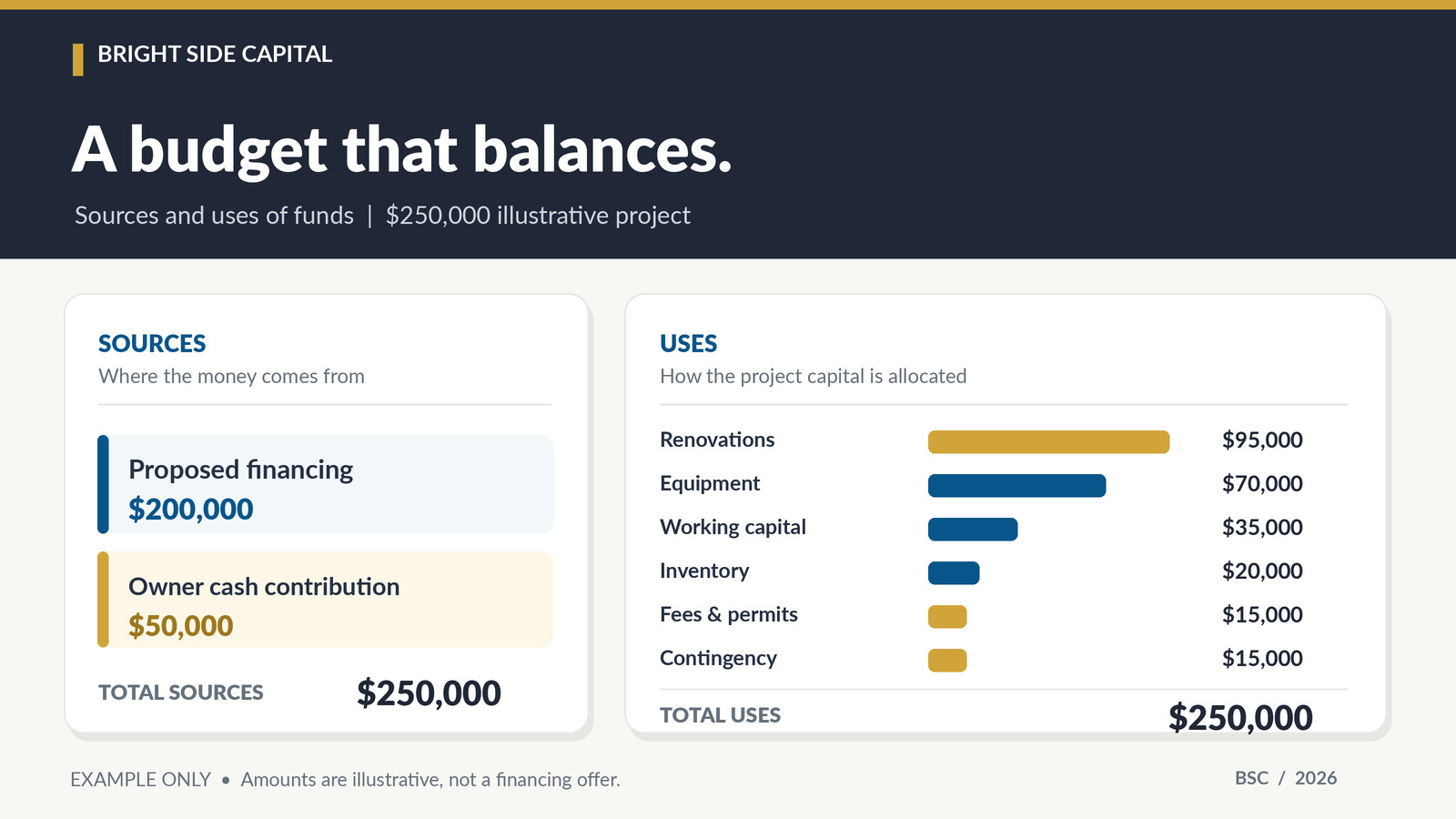
The estimated project budget totals $250,000.
Proposed Uses of Funds
- Leasehold improvements: $95,000.
- Kitchen and operating equipment: $70,000.
- Initial additional inventory: $20,000.
- Working capital: $35,000.
- Permits, professional services, and closing costs: $15,000.
- Project contingency: $15,000.
Total Uses of Funds: $250,000
Proposed Sources of Funds
- Proposed commercial financing: $200,000.
- Documented owner cash contribution: $50,000.
Total Sources of Funds: $250,000
In this illustration, the proposed sources and planned uses balance at $250,000.
The $200,000 loan is hypothetical and has not been approved. The owner’s $50,000 contribution is also an assumption for the example, not a universal down payment requirement.
The business should verify individual estimates using contractor proposals, equipment quotes, inventory projections, lease documents, and other applicable records.
It should also make sure the $35,000 working-capital allocation reflects realistic operating needs during the project. A renovation may create costs before the improved facility generates additional revenue.
For related considerations, see our business financing readiness checklist.
How to Prepare a Sources and Uses of Funds Statement
Step 1: Define the Project and Its Financial Purpose
Start with a clear description of what the business intends to accomplish.
A useful explanation identifies the actual investment rather than relying on a broad statement such as “business growth” or “working capital.”
For example, a manufacturer may be purchasing a new production machine to increase capacity. A restaurant may be renovating its kitchen to improve operations. A contractor may need equipment and materials to support additional projects.
Write down what the project includes, what it is expected to cost, and when the business anticipates receiving the financial benefit.
The purpose helps determine which expenses belong in the budget and which financing structures may be appropriate.
Step 2: Collect Supporting Quotes and Cost Estimates
Build the uses section using the best information currently available.
Supporting documents may include:
- equipment purchase quotes;
- construction or renovation estimates;
- inventory purchase orders;
- commercial property contracts;
- business purchase agreements;
- lease and tenant-improvement estimates;
- professional fee estimates; and
- working-capital projections.
Identify whether each amount is confirmed, estimated, or subject to change.
A preliminary contractor estimate should not be presented as a guaranteed final construction cost. Similarly, a proposed equipment purchase price may not include freight, installation, taxes, training, or other expenses.
For asset purchases, our guide to financing new business equipment explains several additional costs owners should evaluate.
Step 3: Calculate Working Capital Separately
Working capital deserves its own budget category when a project requires operating cash beyond the purchase price of the underlying asset or improvement.
For example, a business opening another location may need funds for staffing, inventory, utilities, insurance, and other operating expenses before customer revenue reaches a sustainable level.
A manufacturer adding production capacity may need additional raw materials and payroll while waiting for finished products to be sold and customer payments to arrive.
Estimate these needs using expected receipts, payroll schedules, supplier terms, and the timing of other operating expenses.
Our 13-week cash flow forecast guide explains how to model near-term cash receipts and payments.
Do not confuse a budgeted working-capital reserve with money that has already been spent. It represents cash allocated for expected operating needs and should be tracked accordingly.
Step 4: Identify Each Financing and Equity Source
After estimating the project costs, identify how the business proposes to pay for them.
Separate owner contributions, requested loans, available financing facilities, and other sources.
For each proposed source, record the amount, current status, applicable conditions, and any restrictions on how the money may be used.
If the business plans to contribute existing cash, confirm that those funds are genuinely available after accounting for payroll, taxes, supplier commitments, and other operating obligations.
If the project relies on borrowed money, remember that a preliminary financing estimate is not the same as final approval or an unconditional funding commitment.
Do not count the same money twice. For example, an owner contribution already reflected in the business’s available cash should not also be added as a separate new source unless the accounting and transaction structure support that treatment.
Step 5: Account for Financing Fees and Net Proceeds
One important source of confusion is the difference between the amount approved and the amount actually disbursed.
Suppose the hypothetical $200,000 financing source from our restaurant example includes a $4,000 fee deducted from the gross loan proceeds.
The business would receive $196,000 in net cash from that source, assuming no other deductions.
If the sources and uses statement reports the gross $200,000 loan, the $4,000 financing fee should also be reflected among the transaction’s uses or otherwise properly reconciled. In our example, it could be included within the $15,000 allocated to professional services and closing costs.
That leaves $196,000 in net loan cash and $50,000 in owner funds available for the remaining $246,000 of project costs.
Do not count the $4,000 fee twice or overlook the reduction in usable proceeds.
The actual treatment depends on whether a fee is withheld, financed, paid separately, or handled another way under the agreement.
Our business financing fees guide explains how different charges may affect the amount a business receives and repays.
Step 6: Verify That Sources Equal Uses
Once the figures have been entered, calculate the total proposed sources and total estimated uses.
If the totals do not match, determine why.
A shortfall may indicate that the project requires more capital, that certain expenses should be reduced, or that another funding source needs to be identified.
An excess may mean the business has overstated its funding request, omitted an intended use, or included capital that does not actually belong in the transaction.
Balancing the totals is necessary, but it does not establish that the project is affordable or financeable.
A lender may still determine that the requested amount exceeds the business’s repayment capacity, that certain expenses are ineligible, or that additional documentation or equity is required.
Step 7: Test the Financing Plan Against Cash Flow
The final step is to consider what happens after the funds are spent.
A balanced sources and uses statement establishes how the project will be financed. It does not demonstrate that the business can support the resulting payments.
Estimate the proposed financing payment and compare it with operating cash flow, existing obligations, and the expected financial benefit of the project.
For projects involving equipment or renovations, consider how long the investment will take to begin generating revenue or producing savings.
For an acquisition, consider the acquired company’s historical results, transition expenses, and any new obligations created by the transaction.
For an installment loan, our business loan amortization schedule guide explains how scheduled payments affect interest and outstanding principal.
The objective is to finance a complete project without creating a repayment obligation the business cannot reasonably support.
How Sources and Uses Differ Across Financing Programs
The same project budget may be evaluated differently depending on the financing product.
Conventional Business Financing
A conventional term loan or other commercial credit facility may support an approved business investment, subject to the lender’s policies and underwriting.
The lender may review the project budget, borrower contribution, existing obligations, collateral when applicable, and the anticipated source of repayment.
Not every conventional lender finances every category of expense. The approved loan purpose and documentation requirements matter.
SBA 7(a) Financing
SBA 7(a) financing through participating lenders may support several eligible business purposes, including certain working-capital needs, equipment purchases, qualifying real estate, eligible business acquisitions, and other approved uses.
A detailed project budget can help the lender determine which costs are eligible and how the requested amount relates to the complete transaction.
The lender must still evaluate applicable SBA rules, borrower eligibility, equity requirements when relevant, repayment ability, and the supporting documentation.
Our guide to what an SBA loan review checks explains those underwriting considerations.
SBA 504 Financing
SBA 504 financing focuses on qualifying major fixed assets, such as eligible real estate, construction, renovation, and certain long-life equipment.
Unlike eligible SBA 7(a) transactions, 504 financing cannot generally be used for ordinary working capital or inventory.
A business considering a 504 structure should therefore separate qualifying fixed-asset expenses from other operating needs and identify appropriate financing for any costs that do not fit the program.
Program requirements, lender policies, borrower contributions, and approved costs must be confirmed under the rules applicable to the actual transaction.
Equipment and Commercial Real Estate Financing
Asset-specific financing commonly requires additional detail about the property or equipment being acquired.
For equipment, the provider may review purchase price, installation, useful life, collateral value, and related costs.
For commercial property, the project budget may need to account for down payment, appraisal, title, environmental review, legal fees, improvements, taxes, insurance, and other applicable expenses.
See our commercial property purchase financing guide for related acquisition and closing considerations.
Common Sources and Uses of Funds Mistakes
A sources and uses statement should be consistent, complete, and supported by the available records. Common mistakes include:
- Leaving out transaction expenses: Failing to include applicable closing costs, delivery fees, permits, installation expenses, or other project costs.
- Underestimating working capital: Budgeting only for the purchase or renovation while overlooking operating cash needed during the transition.
- Treating proposed funding as approved: Presenting an uncommitted financing request as money already available.
- Double-counting available cash: Listing the same owner contribution or business funds in more than one source category.
- Ignoring financing deductions: Assuming the gross approved amount equals the usable amount after fees.
- Combining unrelated expenses: Using vague categories that prevent a financing provider from understanding the actual project.
- Overlooking program eligibility: Assuming every project expense may be financed under every business loan or SBA program.
- Failing to update estimates: Using an outdated construction budget, equipment price, or acquisition figure after the transaction changes.
- Confusing project funding with repayment: Treating expected future sales as immediately available project cash when those receipts have not yet been collected or otherwise made available.
A balanced statement should reflect a feasible transaction, not simply numbers adjusted to produce matching totals.
Frequently Asked Questions About Sources and Uses of Funds
Do sources and uses of funds have to match?
Yes. A complete sources and uses statement should show how the full project budget will be funded. Total sources should equal total uses. However, matching totals does not guarantee that the proposed financing will be approved or that all identified funds are available.
Is a sources and uses statement the same as a business budget?
Not exactly. A sources and uses statement summarizes the funding plan for a particular transaction. A broader business budget may project revenue, expenses, and financial activity over an operating period. The two can support each other but serve different purposes.
Can owner cash be included as a source of funds?
Yes, when the owner intends to contribute available funds to the project. The financing provider may request evidence of the funds and may evaluate whether the contribution meets applicable program or transaction requirements.
Should financing fees be included in uses of funds?
Applicable fees should be accounted for in the complete transaction budget. Their treatment depends on whether they are paid separately, deducted from financing proceeds, or financed under the agreement. Costs should not be omitted or counted twice.
Does every business financing application require this statement?
No. Documentation requirements vary by financing provider, program, loan amount, and transaction. A detailed sources and uses schedule may be particularly helpful for acquisitions, real estate purchases, major equipment projects, and business expansions.
Is the sources and uses statement proof that a business can repay financing?
No. It explains how a transaction will be funded and where the money will be allocated. Repayment capacity must be evaluated separately using relevant cash flow, financial statements, existing obligations, and other underwriting information.
Build a Financing Plan Around the Complete Project
A sources and uses of funds statement helps business owners understand the full cost of a project before committing to additional financing.
By identifying every significant expense, documenting proposed capital sources, and accounting for working capital and closing costs, the business can prepare a more realistic request.
Before selecting a financing structure, compare the net amount available, total financing cost, repayment schedule, applicable fees, collateral requirements, and effect on operating cash flow.
Our business financing offer comparison guide explains how to evaluate those factors.
Bright Side Capital uses a multi-program approach to help business owners explore and compare commercial financing programs and providers based on the project, use of funds, revenue, cash flow, existing obligations, credit profile, and repayment capacity. Availability, eligibility requirements, costs, and financing terms vary by provider and program.
If you are planning an equipment purchase, business expansion, acquisition, or other commercial financing project, complete the Bright Side Capital Business Survey to explore financing options that may fit your business needs.